• Polski
Plus Energia - sale and distribution of electricity

We are a partner for commercial property owners by providing them with energy solutions that generate profit, increase property value and help them on the road to green transformation.

100 Years of Experience in Real Estate
41 Supported Buildings
93% of Customers Extened Contracts with Us
550 Thousand m2 of Leased Area Serviced
5 Models of Cooperation

    Our Clients

    White Star Real Estate Sp. z o.o.

    Peter Huntley – Chief Executive Officer
    „Plus Energia has provided electricity to our Retail Park shopping center, both for the common areas and to individual tenants, since the center opened in April, 2011. We have found them to be a consistently reliable, flexible and constructive partner.”

    Karuzela Park

    Joanna Marczak
    „Firmę Plus Energia możemy polecić jako solidnego i wiarygodnego partnera w stosunkach handlowych. Codzienna współpraca układa się bardzo dobrze, również za sprawą kompetentnych fachowców, rzetelnie wywiązujących się z zobowiązań”

    Outlet Center Białystok

    Dawid Bieluczyk – Dyrektor
    „Od początku współpracy firma wykazywała doskonałe przygotowanie merytoryczne oraz szeroką wiedzę praktyczną w zakresie optymalizacji kosztów energii, wyboru mocy i taryf do rozliczania za sprzedaną i dostarczaną energię elektryczną”

    Empetis – budynek biurowy w Warszawie

    Jan Kalinski
    „Po przeprowadzonej analizie energetycznej i wprowadzeniu zmian w obiekcie Empetis, zlokalizowanym w Warszawie przy ulicy Krakowiaków, opłaty za energię elektryczną w części dystrybucyjnej zmalały o prawie 30%.”

    Galeria Słoneczna Radom

    Paulina Dudzik – Deputy Center Manager
    „Plus Energia świadczy swoje usługi dla ponad 120 najemców w naszej galerii, wśród których znajdują się najbardziej rozpoznawalne marki na rynku polskim i światowym, co potwierdza fakt, że Plus Energia jest w stanie świadczyć swoje usługi nawet dla najbardziej wymagających firm.”
    Logo Outlet Center
    Logo Multi
    Logo Galeria słoneczna
    Logo White Star Real Estate
    Logo Galeria Królewska
    Logo Karuzela
    Logo The Park Warsaw
    Logo Radom Office Park
    Logo Praga 306
    Logo DL Invest Group
    Logo Galeria nad Potokiem
    Logo Premium Park Łowicz

    News from the world of energy

    Why is it worth using an energy advisor today?

    Why is it worth using an energy advisor today?

    The energy market has changed more than many property owners realize.

    Just a few years ago, purchasing energy for a commercial property was relatively simple. A building manager would receive several offers, compare prices, and sign a contract for one or two years.

    Today, this model is too simplistic.

    The energy market has undergone a massive transformation in recent years – from extreme price spikes during the energy crisis to entirely new phenomena related to the green energy transition and the development of renewable energy sources.

    The effect?
    Energy prices are no longer stable, and the decision to purchase energy has become a strategic one.

    The energy market has become volatile.

    In 2021–2022, electricity prices in Poland reached historic highs.

    On the BASE futures market, prices even exceeded PLN 1,700/MWh, while previously, PLN 300–400/MWh was the norm.

    Today, the situation is different – ​​prices have returned to levels around PLN 400–450/MWh, but this does not mean stability. Quite the opposite.

    The market is much more complex today and dependent on many factors:

    • renewable energy production
    • gas and CO₂ prices
    • weather conditions
    • geopolitical situation
    • development of energy storage
    • European regulations

    Therefore, the timing of purchasing energy has great importance on the operating costs of the property.

    Renewable energy is changing the market logic

    One of the most important factors driving market change is the rapid development of photovoltaics.

    During the summer months, PV production in Poland reaches levels exceeding 8–9 GW at midday, creating strong downward pressure on energy prices during those hours.

    At the same time, prices often rise sharply in the evenings – when PV production declines.

    In practice, this means:

    • energy can be very cheap during the day
    • energy can be significantly more expensive in the evening

    This volatility will only increase with the continued development of renewable energy sources.

    For property owners, this means one thing:

    A project’s energy consumption profile is starting to have a real impact on costs.

    One price for all is no longer viable.

    Many commercial properties still operate under a single fixed energy price model for the entire facility.

    However, the energy consumption profile in office buildings, logistics centers, and retail parks is completely different. This consumption profile is also crucial when deciding on a PPA or building your own renewable energy source.

    Therefore, the energy purchasing strategy should be tailored to the property’s characteristics.

    This is where the role of an energy consultant comes into play.

    Energy Advisor – More Than Just a Seller

    Modern energy consulting isn’t about finding the cheapest offer from a seller.

    The consultant’s primary role is to:

    Energy Consumption Profile Analysis

    – When does a building use the most energy?
    – What is the seasonality like?
    – What are the optimization opportunities?

    Energy Purchasing Strategy

    This may include:
    – purchasing energy in tranches
    – futures contracts
    – indexing to the market
    – combining several purchasing modelsTaking advantage of new market opportunities

    The following aspects are increasingly being considered:
    – Renewable Energy PPA
    – Self-consumption of energy from PV
    – Energy storage
    – Consumption profile management
    Energy Market Monitoring

    The energy market changes daily.
    A professional advisor analyzes, among other things:
    – prices on the Polish Power Exchange (TGE)
    – the futures market
    – renewable energy production forecasts
    – the situation on the gas and CO₂ markets

    This means that the decision to purchase energy is not a one-time event, but rather part of an ongoing cost management strategy.

    In the future, the energy market will become even more dynamic

    The coming years will bring further changes:

    • dynamic growth in PV capacity
    • development of energy storage
    • new PPA contract models
    • increasing volatility of hourly prices
    • geopolitical turmoil and related fluctuations in commodity prices

    Therefore, energy management will increasingly resemble portfolio management rather than simple service purchasing.

    And in such conditions, good decisions require data analysis and market experience.

    Obrazek posiada pusty atrybut alt; plik o nazwie image-2.png

    Summary

    For commercial property owners and managers, energy is becoming one of the most important areas of cost optimization.

    The difference between a good and a bad energy purchasing strategy can mean hundreds of thousands of zlotys annually for a larger project.

    Therefore, more and more companies are choosing to work with an energy consultant who:

    • analyzes the market
    • prepares a purchasing strategy
    • monitors prices
    • supports energy-related investment decisions

    Because in today’s energy market, the most expensive decision is to have no strategy.

    OSDn (Local Distribution Network) Model: Innovative Energy Management in the Warehouse Industry – Benefits for Owners, Investors and Tenants of Logistics Parks

    OSDn (Local Distribution Network) Model: Innovative Energy Management in the Warehouse Industry – Benefits for Owners, Investors and Tenants of Logistics Parks

    A Distribution System Operator, known by the acronym DSO, is a specialized form of electricity distribution management in closed, local networks that are not directly connected to the main transmission grid. In practice, this means that the DSO operates as an independent entity responsible for operating energy infrastructure in limited areas, such as industrial parks, logistics centers, or warehouse facilities.

    Its role includes coordinating energy supply, ensuring grid stability, and facilitating the integration of modern solutions, such as renewable energy sources. Unlike larger operators, the DSO focuses on the specific needs of the closed system, allowing for more flexible energy management tailored to local conditions.

    This solution fits into the broader context of the energy transition, where the emphasis is on efficiency and sustainability, enabling commercial entities to treat energy not only as a cost but also as a potential source of added value. In the warehouse industry, where logistics parks are key elements of global supply chains, implementing the DSO model offers numerous benefits, transforming traditional energy infrastructure into an active revenue-generating tool and increasing facility competitiveness. Owners of such properties can derive stable income from leasing the power grid to a licensed operator, providing a predictable financial stream for up to ten years, without the need for additional capital expenditures for expansion or modernization. Such a lease not only frees up capital for other purposes but also increases the overall value of the property, making it more attractive to investors seeking assets with high return potential.

    Tenants of warehouse parks benefit from this solution by being able to independently choose their energy supplier, known as the TPA principle, which allows them to negotiate more favorable tariff terms and tailor contracts to their individual operational needs. Additionally, this model facilitates contracts for the purchase of green energy directly from producers, supporting sustainable development goals and helping to meet the environmental, social, and governance standards increasingly required by large market players, such as international logistics corporations. As a result, warehouse parks utilizing the DSO model become more desirable. This translates into longer lease terms, lower tenant turnover, and higher rental rates, ultimately strengthening the landlord’s position in the commercial real estate market.

    Reducing financial risk is another aspect when the DSO takes over responsibility from the facility owner for settlements, payments and debt collection from tenants.

    Thanks to the DSO model, integrating renewable energy sources, such as photovoltaic panels installed on warehouse roofs, enables the sale of generated green energy to tenants, increasing property owner profits and ensuring a faster return on investment while simultaneously improving the environmental footprint.

    For investors in the logistics sector, the DSO model means treating energy infrastructure as a strategic asset that supports long-term portfolio value growth, particularly in the context of the growing demand for “green” facilities, where energy efficiency is becoming a key decision-making factor in location selection by companies focused on sustainable development. As a result, implementing this model not only optimizes the daily operations of warehouse parks and enables the flexible addition of consumption points, which is crucial for growing logistics parks, but also positions them as leaders in the energy transition, attracting investment funds interested in low-risk assets with high environmental potential.

    ESG in the Context of DSO Applications  The DSO model fits perfectly within the ESG framework, where E – Environmental refers to the reduction of CO2 emissions through the integration of renewable energy sources and distribution optimization, which minimizes environmental impact. S – Social Responsibility (SR) emphasizes benefits for the community, including ensuring a stable energy supply for tenants and supporting local environmental initiatives, which builds a positive company image. G – Corporate Governance (GSR) encompasses transparent management of the energy network in accordance with regulations, ensuring legal compliance and business ethics, increasing investor confidence.

    To better illustrate the practical aspects of DSO in the warehouse industry, we must consider potential application scenarios. In a typical logistics park covering tens of thousands of square meters, where energy consumption is high due to lighting, ventilation systems, and automation, DSO enables the creation of a microgrid in which energy from local sources powers the common areas of the property or is sold to tenants. Investors can thus diversify their revenue streams (NOI) by combining traditional leases with additional revenue from energy management, which in the long term increases the asset’s capitalization. For the fiercely competitive commercial real estate sector, this approach is becoming a strategic advantage, particularly in Poland, where the development of warehouse parks is driven by e-commerce and international trade.

    The table below presents examples of estimated DSO impacts on key indicators in a medium-sized warehouse park, based on general industry analyses:

    Indicatorwithout DSOwith DSOEstimated ImprovementAnnual energy costsHigh, dependent on external tariffsReduced thanks to the sale of green energyUp to 20-30% in savingsProperty valueStandard, no ESG premiumElevated thanks to a balanced profileGrowth ~10-15%Tenant turnoverHigh, due to lack of flexibilityLow, due to satisfaction with energy servicesReduction ~15-25%Additional incomen/aFrom leasing the network and selling green energy to tenantsStable for 10 years, around PLN 100,000-200,000 per year, with a faster return on investmentCO2 emissionsHighReduced via green energyReduction ~20-40%

    In the context of broader trends, DSO supports the development of “green warehouses,” where energy becomes an integral part of the business strategy. In logistics parks, integration with energy storage allows for the storage of surplus photovoltaic energy, which stabilizes supply and maximizes revenue from energy sales.

    For owners, this translates not only into financial benefits but also reputational benefits, as facilities compliant with ESG principles attract tenants and facilitate access to financing for green projects.

    In Poland, where the logistics sector is growing rapidly, the DSO model is becoming a tool for adapting to changing environmental regulations, ensuring competitiveness in the European market.

    In summary, DSO represents a modern approach to energy management in the warehouse industry, where the benefits of its implementation include not only direct revenues and savings but also a strategic position in the commercial real estate market. For logistics park owners, investors, and tenants, this solution opens up new opportunities, making energy infrastructure a key element of business success. More information about implementations and potential analyses can be found at www.plusenergia.pl.

    Autor: Krzysztof Daszkiewicz-Bortnowski

    This is the climate we have – importance of changes on the present energy market for business

    This is the climate we have – importance of changes on the present energy market for business

    The period of the past 22 years for our energy sector was a period of development.  When in 1997 the energy law was adopted, it only comprised 13 pages, and in 2019 the same act comprised 235 pages, including numerous legal documents, and more than 20 valid regulations and implementing acts. This came up to a total is a few thousand pages of documents with comments. Some may thin that this is simply too much to allow problem-free operation operate on the energy market, but on 28 December 2018 the Ministry of Energy published an act on amendment of the act on excise tax and certain other acts – commonly referred to as the “electricity law”. Many energy experts insist that the electricity act along with its amendments has set back our energy market to the time from before market liberalisation in 2007, when the major part of companies and households were unable to purchase electricity from any random seller. The same limitation concerns energy prices for 2019.

    To be able to move around the energy market more effectively enterprises, including those from the sector of commercial properties, frequently seek support of energy advisers. If such an adviser has the required know-how and is well familiar with the Real Estate market, most likely he would first review the situation of the given enterprise and advise which measures could be adopted, or congratulate if he finds that everything is as it should be. Below are the basic issues of this market and possibilities of coping with the oligopolistic domestic energy market.

    Production

    The general opinion is that there are three things of importance in business: location, location and … location. This is well known to all participants operating in the sector of commercial properties, such as shopping malls, commercial parks or office buildings. For the Polish power industry also of great importance is the location – the geographic situation of Poland is highly connected with the resources we use for energy generation. Coal? Gas? Renewable energy sources? Although energy generation in Poland is mainly based on coal, yet in the period of 1990 – 2018 the share of coal in production fell from 98% to 82%. The good information is also that the share of production from renewable energy sources in 2018 came up to more than 10%, and everything points out to the fact that the rate of changes for the forthcoming years would be on the side of RES. Locations used for energy generation may be lands that surround commercial facilities, as well as surfaces of parking lots and roofs. An owner of a commercial facility has many options of using own energy generation. One of the most commonly used is the installation of photovoltaic panels. Nowadays such installations are much lighter than before, and that enables their installation also on structures which are already in existence.

    Enterprises increasingly go for the purchase and installation of their own energy generation sources. Commercial buildings, the owners of which want to benefit from the BREEM and LEED certification, or those that are aware of savings from their own generation, tend to perceive such an installation not only from the viewpoint of energy independence, but also as an investment in the project. In many Western European countries the RES installation keeps attracting additional investors and serves as a sort of a magnet, while on the other hand it contributes to environmental protection and improving the life quality.

    A financial analysis of a 50 kWp installation furnished on the roof of a commercial building allows a rerun in ca. 9.5 years – but given the growing energy prices this period may even be shorter. On the other hand, if an investment in an installation is combined with an agreement on the electricity sale, additional financial liquidity is gained, for example the energy enterprise may finance the investment.

    Currently a real boom is taking place in the Polish sector of photovoltaic installations (PV). At the end of 2018 the total capacity of installed PVs in Poland achieved almost 0.5 GW, the major part of which is capacity in microinstallations (installations below 50kWp ”kilowatt peaks”, i.e. peak power ratio at optimum weather conditions). In mid-2019 it has already become certain that the potential of photovoltaics would exceed 1 GW. Microinstallations are mainly built by private persons and in small and medium enterprises. According to projections, at the end of 2019 there will be ca. 50 thousand new PV installations connected to the grid (the current number will be doubled).

    Usage is to keep growing

    Is own energy generation a way to guarantee energy security? Are there possibilities of assuring secure and “cheap” electricity? Can the so-called “electricity law” serve as a driving force for energy autonomy? Can one make profits on energy?

    In 2018 for the very first time the domestic energy consumption exceeded the value of 170 TWh. The majority of experts, including those from Polskie Sieci Elektroenergetyczne, anticipate a further increase in the demand for electricity, and data from the past 20 years suggest that energy consumption in Poland has changed by 123%. On Thursday 25 June the government adopted a draft amendment of the act on renewable energy sources. The amended act also opens a lot of new possibilities, among others by expanding the definition of PROSUMENT by enterprises. To put it briefly this means that procedures for companies interested in energy generation for their own needs would be considerably simplified, and that companies from the Real Estate market may be considered such enterprises.

    The demand for own power arises in the first place from the fact that electricity costs are growing and will keep doing so in the future. According to forecasts of the Institute for Renewable Energy, by 2020 electricity generation costs would grow by almost 50% as compared to 2018, and analysts of Credit Agricole anticipate that at the beginning of 2020 wholesale prices would increase by at least 40% as compared to what enterprises have paid a year earlier. What is the best moment for purchase of electricity? We recommend the purchase of energy based on an analysis of internal needs, without unnecessary delay. It is even worthwhile to consider buying two or three years in advance. An analysis of the last three months suggests that energy on 2020 has grown by 4.1%, on 2021 by 6.1%, on 2022 by 2.9%.

    “Electricity Law”

    Growing energy generation costs, including among others higher costs of CO2 emission from coal and bigger demands of domestic energy consumption have “driven” the prices of electricity to grow in 2018 to historically the highest levels in the Polish Power Exchange, exceeding the threshold of 320 PLN/MWh of black energy (price prior to imposing of such levies, as the excise tax and property rights). The objective of the adopted electricity law, its amendments and the regulation (as on the date of this article the regulation has not been published yet) is to maintain in 2019 the energy price level for the final customer (among others households, enterprises, hospitals, self-government bodies) at the level of prices of 30 June 2018. The last amendment from June 2019 clears the majority of concerns as to which customers the electricity law is addressed at, and which procedures are to be executed by specific groups of recipients. Further amendments, short period available for its deployment, in some cases cause chaos among recipients who have doubts as to their ultimate obligations and privileges.  And they also have to think of their current activity.

    Although the electricity act is meant to maintain prices in 2019 at the level from 30 June 2018, if the given recipient fails to meet certain obligations, it may turn out that the electricity law would cease to apply to it. One of the obligations of the final recipient is to submit a declaration to the energy enterprise. Entities authorised to freeze the rates must submit a declaration in this respect by 27 July. Another obligation, also on the part of the customer, is to submit to the energy enterprise an invoice or a duplicate invoice comprising the date of 30.06.2018 in its settlement. We encourage final customers to become acquainted with all their obligations and rights, including implementation deadlines.

    Also energy enterprises have their obligations and deadlines. If a customer requests the issuance of a duplicate invoice, the energy enterprise has three days to issue such a document. A valid duplicate invoice should comprise the word “duplicate” and the date of issuance.

    A review of the commercial properties market suggests that the electricity law may cause an unexpected and rather painful obligation on the part of administrators and owners, as well as customers. Calculations for the media are as a rule made until the end of the month n+1 for month n. As a rule the mechanism of the so-called service charge is used in the settlements, and its value is known to the parties at the end of the given year. And so if an investor would find have the right to obtain adjustments for the first half-year of 2019 (and potentially?) for the second half), it would be bound by lease agreements to carry out appropriate settlements also with its tenant in this respect. Provisions of lease agreements should be verified, because there might be a possibility of making settlements with the oncoming payments.

    Even though the electricity law leads to a lot of controversies both on the part of the recipient, as well as the energy enterprise, it serves as a certain type of beacon for the market. Its introduction for this year has many positive aspects, such as for example the fact that in the location in which we reside no increase would be introduced in electricity bills on the sales side. However, business relations frequently comprise most extreme situations – it many cases the customer does not know where to turn to for the most basic information concerning his settlement. On the other hand, there are customers who did not base their choice of an energy enterprise by a single criterion, but also considered business relations, with dedicated adviser, with cyclical support. When an occupier in a commercial facility turns to the property owner with queries pertaining to the electricity law, good relations with one’s energy seller is generally appreciated.

    The future – which way to look

    Is it really unavoidable that powering is associated only with a cost invoice? Is there any possibility at all to have security of supplies, safety of solutions, stabilisation or consulting related to energy issues when choosing an energy solution? If the energy enterprise and final customers were in a partner-partner relation, they would be able to adopt dedicated solutions for each buyer, meeting the relevant market requirements. Choosing relations of the partner-partner type all parties could achieve long-lasting advantages.

    The author of the text is Marcin Wnuszyński, Director of Operations at Plus Energia.

    Source: https://retailnet.pl/2019/07/31/1035-plus-energia-taki-mamy-klimat-konsekwencje-dla-biznesu/

    Green energy is a positive value for business!

    Green energy is a positive value for business!

    Recently the Polish energy market has been undergoing highly dynamic changes. It all began with quickly growing energy prices and several changes to legal regulations, including also the “electricity law”, which all have their reflection on market behaviour. Not to forget EU standards that pertain to renewable energy. The present situation signifies that energy prices would continue to grow, among others in connection with dependence on the so-called “black energy” and carbon supplies. Analysts anticipate that wholesale prices in 2020 would grow by at least 40%! The more Poland deviates from other EU countries with respect to the energy policy, the more costly will this dependence turn out to be. Yet this does not have to happen if we keep up with the EU and become oriented at “green energy”.

     “Green energy” – development of photovoltaics in Poland

    The European photovoltaic market is doing quite well and is currently experiencing a real boom, which may be proven by the dynamic growth of the installed capacity in photovoltaic sources over the past year. Progress in Poland is quite impressive, and in the past few years it has distinguished itself as compared to the remaining EU Member States. In 2018 Poland occupied a high 9th position as regards the increase of installed capacity in photovoltaic sources, and it may not be ruled out that already 2019 we may achieve even the fourth position from among all EU countries! This could have been facilitated by numerous legal changes that have been recently introduced, which definitely contribute to the availability of photovoltaic solutions and the growing interest in those installations in Poland.

    A key change is that in line with the amendment of the Act on Renewable Energy Sources of 19 July 2019, the maximum capacity for a photovoltaic microinstallation was increased from 40 to 50 kW. Those types of microinstallations require no building permit, and what is more, it is also possible to expand an already existing installation to 50 kW, with no additional formalities required, which makes the process much easier.  Changes also apply to the capacity of small installations, which is currently contained within the range from over 50 kW to below 500 kW. At present this type of installation does not require obtaining a concession for electricity generation. Photovoltaics is becoming more investment-friendly, because its cost and mounting technology is much more affordable than it was before. Given the decrease in wholesale FV panel prices in China (decrease of ca. 20%) and the abolition of customs charge for import, a clear reduction is observable of the price of photovoltaic panels in the entire EU. What is more, as the number of installation companies keeps growing, the installation offer is becoming more advantageous, better adapted to the recipient and better affordable than before.

    Business customers, most frequently SMEs under the C tariff connected to the low voltage grid, have to pay the highest rate for electric power (including network services). Given the present developments, the regulatory situation and the available possibilities, including all types of co-financing for projects in renewable energy sources, the best solution to suit your type of business should be sought. Thanks to co-financing from EU means available to entrepreneurs, leasing and credits dedicated to the sector of RES installations, or financial solutions offered by energy-selling enterprises, photovoltaic microinstallations are going to bring their owners bigger and more measurable advantages. Photovoltaic installations may be used for own needs and may also serve as a basis for activity consisting in the generation of electric power. In this first case companies may become prosumers.

    A business prosumer is a type of enterprise that has its own RES installation (such as photovoltaic installation on the mall roof) that uses the major part of generated energy for its own needs, and the generated surplus power is sold to the contractual seller at prices that arise from the present energy market. Until not long ago only legal persons could be prosumers, but the above mentioned amendment of the act on RES has extended this right also onto business entities.

    At present the biggest Polish energy producers have started to make considerable investments in “green energy” and increasingly often base their business activity also on the generation of energy from renewable sources. Drafts of the Energy Policy of Poland until 2040 and the National Plan for Energy and Climate up to 2030 foresee continuous development of photovoltaic installations. According to the draft the Energy Policy of Poland it is estimated that in 2040 there will be a total capacity of over 20.2GW from photovoltaic installations, which comes up to 25% of the entire installed power!

    In response to intensifying environmental problems and health-related problems, the European Union has taken up a fight against CO2 emission, and its policy is clearly oriented at reducing carbon dioxide emission, of which the biggest emitters are producers of coal-based electric power (30% of CO2 released to the atmosphere). Counteracting smog is one of key priorities of the European Union in the financial perspective of the period 2021-27.

    Photovoltaics – how to do it?

    As we are already aware that powering of a building with solar energy is an affordable and reasonable solution that allows investing in the future, not only as regards our business activity, but also investing in the future of our planet, then what should a commercial building owner do to adopt this solution in his own facility?

    First of all the best solution should be selected in consultation with an advisor specialised in photovoltaic panels, as regards the size of the PV system, type of panels and assembly structures. The procedure of connecting a microinstallation is not as complicated as it may seem. Currently each entity that generates its own electricity from photovoltaic panels (and other renewable energy sources) has the right to connect its installation to the power grid and gain the ensuing benefits.

    In the assembly process of a photovoltaic installation its proper execution should be assured, in line with relevant technical and legal requirements, as well as a guarantee of the operational safety of the system and the wiring in the building. It is important that the installing entity has appropriate licences for installation of renewable energy sources. This may be easily verified, as generally such an entity/person has a certificate or other document qualifying to execute installations and operate equipment and the grid. In practice well installed panels operate faultlessly, and their lifetime is at least 20 years. What is more, correctly installed panels are characterised by considerable resistance to adverse weather conditions.

    Changes have also been made to regulations of the act the Building Code. Beforehand fire protection regulations would only regulate issues concerning disconnection of powering (in the event of a fire hazard) obtained directly from the power grid, and presently there is also a requirement that photovoltaic installations also have to be connected to the power disconnection system. In such a way in the event of a fire the installations pose no danger to the firefighters.

    Most likely our readers wonder where they could possibly locate such an installation? Maybe you think that you have no appropriate or sufficient place to be able to invest in this solution. Nothing could be more misleading! Currently photovoltaic installations may be mounted on diverse types of surfaces, which basically range from flat roofs of buildings, parking lot roofing, and naturally elevations and windows. It is vital for the place to have sufficient insolation, attention should be drawn to the inclination angle of the panels, direction of panel situation in relation to the sun or possible shading by adjacent buildings and other installations. It is generally known that panels generate the biggest amounts of energy in spring and summer months: in winter the output of the system tends to fall, yet this does not mean that the installation is not working. Productivity of the installation is considered in an annual scale.

    Green energy – advantage for your business activity

    Investing in photovoltaic panels entails numerous advantages for a business prosumer, and one of them are figures. For the time being the price for a 50kW photovoltaic installation is ca. PLN 180 000.00. Taking into account the current energy prices, the period of return on investment is ca. 8-13 years (with concurrent significant savings). Assuming that energy prices would continue growing and that the technology of photovoltaic installations would keep evolving, this period may be considerably shortened.

    It should be borne in mind that green energy not only involves the financial aspect and the ensuing advantages. Thanks to the usage of renewable energy sources in our facility we may enhance the standard of our property. This is reflected on the occupants, and is also of importance in the event of planned sale of the building and negotiation with the new owner. Building owners who went for this solution are considered socially responsible companies. The business social responsibility is a model concept based on cares for social interest and environment protection, which allows the classification to the Respect Index, i.e. index of socially responsible companies.  Recently there are more and more investments on the market of commercial properties of the kind, such as for example the two-level facility close to Paris belonging to the SEGRO group, which is used by IKEA and LEROY-MERLIN and is fully powered by “green energy”. This facility has been granted the BREEAM certificate, with the assessment “Excellent”, and already now sets out European trends in the usage of renewable energy sources.

    The author of the text is Justyna Kwiatkowska, Sales Support Specialist at Plus Energia.

    Source: https://retailnet.pl/2019/10/01/2255-zielona-energia-to-wartosc-na-plus-dla-biznesu/

    [REPORT] Energy prices will rise

    [REPORT] Energy prices will rise

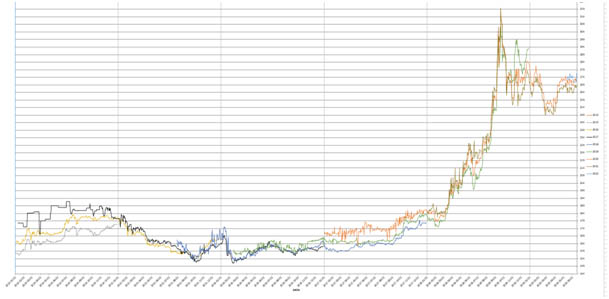
    From the beginning of 2015 through the end of 2017, the price of the next year’s black energy purchased on the stock exchange fluctuated but stayed within a fairly constrained range of approximately 152 – 186 PLN per MwH. In 2018, the electricity market began a ‘new normal,’ increasing gradually in the first quarter before climbing more dramatically starting in April.  By September, the price for 2020 contracts was approaching 320 PLN.  The price for 2020 subsequently dropped back a bit, but has stayed within a range of 250-285 PLN for the past several months – a 100 złoty (or 53-64%) increase per MwH over the “bargain” period of the previous three years. 

    Several industry experts had been predicting increases in energy prices in Poland for some time, but the rapidity of the mid-2018 increase caught even some of these experts by surprise.  It is not quite black swan territory, but the energy landscape has definitely changed, and changed dramatically.  How then did we end up here?  In this brief report, we will examine the primary factors behind the price increases.  We will admittedly present these elements somewhat superficially.  Any one of them could be the subject for a fully detailed article of its own.  But our goal here is to present the big picture with an eye towards understanding where we might be in the coming months… or years.

    EUROPEAN CO2 LAWS

    The European Union has a rigorous initiative in place to cut its greenhouse gas emissions substantially, with the goal to reduce emission levels by 20% in 2020 compared with 1990 levels.  A follow-on goal seeks at least a 40% reduction by 2030.  It is a major element of the EU’s energy policy, and all of its member countries, including Poland, are obliged to adhere to the guidelines.  To assist in helping the market achieve the goals more naturally, the EU put into place an emissions trading system (EU ETS).  CO2 producers receive allowances for emissions, either by getting them for free or purchasing them via auction on the EU ETS.  Reduce your emissions, and you can sell your allowances via the system.  Exceed your allowances, and you must purchase more.  Since approximately 80% of Poland’s electricity comes from the burning of coal, Poland’s electricity producers are active purchasers in the auction system.

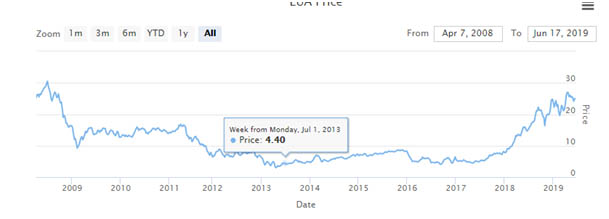
    Beginning in August, 2017, the cost of an allowance for one ton of carbon emission was around 6 EUR.  From then, throughout 2018, and into 2019, the allowance cost increased approximately fourfold, topping out at nearly 27 EUR per ton in April, 2019, by far the highest level since 2008.  There has been direct causality between the increase in carbon emission costs and the electricity prices for end users.  And the consequences may have been understated thus far.  Previously, Poland had surplus CO2 certificates and, as noted above, some producers received them for free.  Now, all certificates must be purchased via the EU ETS, so the impact on pricing for consumers will be more intense.

    One must remember that the EU ETS is a political tool used to help achieve the climate change goals.  And it is structured in a way that the total number of emissions allowances are decreased by 1.74% annually through 2020, and by 2.2% each year thereafter.  In other words, there is a built-in mechanism which encourages these allowances to become more expensive.  Estimates of the prices of the allowances for the next 3 years range from maintaining the current levels to 30 EUR, and we were unable to find any official estimates prognosticating decreases.  And the longer-term estimates run much higher.  Even the slightest increase in CO2 puts upward pressure on Poland’s electricity pricing. 

    PRICE OF COAL PRODUCTION

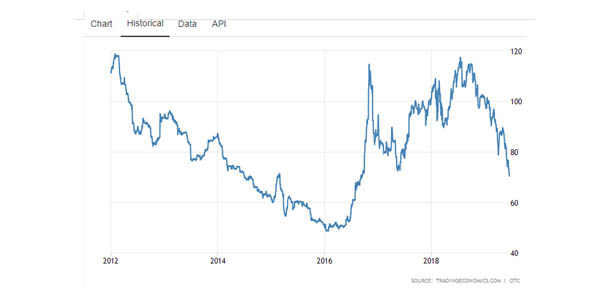
    The average worldwide price of coal rose consistently, and often sharply, from mid-2016, when it was slightly over 50 USD per ton, before reaching a peak of just under 120 USD in the summer of 2018.  At that peak, it was the highest price since 2012.  Again, with more than 80% of Poland’s electricity needs supplied by coal, a more than doubling of the coal price should translate into higher electricity prices.  And it did. 

    Since then, the worldwide coal price has fallen back quite a bit.  As of early June, 2019, it is below 80 USD per ton, levels not seen since the end of 2017.  Under normal circumstances, this should provide some hope of relief from higher electricity prices.  Or if not lower prices, at least stability.

    However, in Poland, the use of coal does not fall into the ‘normal circumstances’ category.  Challenging mining and geological conditions in some of the mines, decreasing production levels and quickly aging infrastructure (including plants that require significant upgrades), among other issues, all contribute to a high cost of coal usage in Poland.  Roughly 100,000 people currently work in the coal industry.  And they are united, thus comprising a powerful political force.  To wit, there are 460 seats in the lower chamber of Poland’s parliament; more than one hundred of them are represented by politicians from the coal-producing regions.  As a result, politicos must cater to that group in order to avoid losing significant support in the elections (and this applies to all parties).  Presented differently, the human resource costs in the coal industry should not be expected to decline.  Moreover, Poland’s focus on energy security as a priority means the support for domestic coal will not decline in the near future.  Polish coal, even with its challenges, is predictable, controllable, and minimizes energy dependence on Russia.  There may be other energy resources down the road – growth in renewables, a potential nuclear option, a shift to more natural gas, etc. – but coal usage is not going away for a while.

    Referring to the previous section in this article, this ongoing reliance on coal also means the cost of the carbon certificates will continue to be an ongoing factor.

    POLAND’S IMPRESSIVE ECONOMIC GROWTH

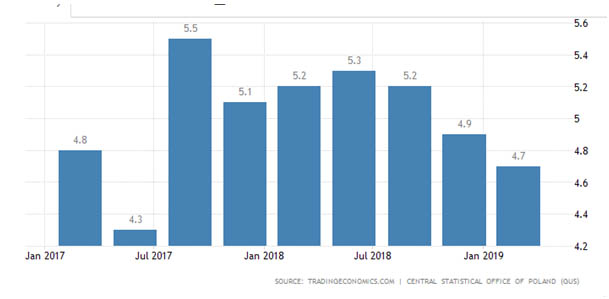
    On June 12, articles appeared in the media announcing record-setting electricity demand** in Warsaw and nationwide (**to be precise, record-setting for this time of year).  Poland’s electricity consumption has been growing approximately 2% per year in recent times.  Demand for electricity is not expected to slow down any time soon in a country that was ranked in the top 15 worldwide for GDP growth per capita between 1990 and 2015.  And the GDP growth has been especially strong over the past two years, with GDP year-on-year growth averaging approximately 5% in each quarter from Q1 2017 through today.  [Note:  Many studies have been conducted on the relationship between electricity consumption and economic growth over the last two decades.  Most of these studies demonstrate at least a strong connection between the two, with some even going so far as to note causality from economic growth to energy consumption (including a report based in Poland and measuring data from 2000 to 2012).]

    This is not to say that the economic growth will directly cause prices to increase, but it is hard for us to see downward pressure on pricing if the demand for electricity continues to rise so steadily.  Rather, it is Poland’s dependency on coal that suggests the economic growth will result in higher prices (for the reasons mentioned above).  While Poland has a plan to become less reliant on coal, it is decidedly long-term.  In the meantime, renewable sources are still in the infancy stage here – in general, growing, albeit without enthusiastic government support, and not yet impactful.  Without a drastic modification of Poland’s green-energy strategy, or truly open borders for electricity purchases, coal will be the primary electricity source.  We expect the prices to react accordingly.

    RECOMMENDATION

    The sum is often greater than the parts.  It is possible the overall electricity pricing picture may include some factors we are not aware of (the apparent court cases on market speculation come to mind).  But the parts here are strongly suggesting increasing electricity prices in the medium term. 

    A good case could also be made that some of the government policies have kept end-user prices artificially low.  The on-again-off-again law which was publicized at the end of 2018 and, as of the day of this writing, still has yet to be finalized, sought to keep prices at June 2018 levels.  While we understand the motivation behind the government’s initiative, we do not believe it is a tenable approach for any meaningful length of time.  In its current incarnation, the law would remove the pricing restraints for medium- and large-sized commercial entities while keeping the fixed prices in place for private consumers and small businesses.  One option we anticipate in that case is that electricity prices for the commercial clients will jump in order to compensate for the potential losses the electricity producers could take in the residential market.

    As such, we are recommending to our clients to buy in advance for next year, monitoring the market closely and taking advantage of any short-term dips in pricing.  And we are eating our own cooking, having just locked in our full-portfolio electricity purchases for 2020 and in the process of moving forward with 2021 as well.

    SCF interview 2019: “Shopping malls and tenants can save considerable resources” says Danuta Tyrowicz

    SCF interview 2019: “Shopping malls and tenants can save considerable resources” says Danuta Tyrowicz

    Almost 10 have passed since you have begun to sell energy to Polish shopping malls and other commercial facilities. Given the dynamics of changes taking place on the market, what would you consider to be your greatest achievement?

    Bartłomiej Chlebek The fact that we continue to grow every year! The founders of our company have gained a lot of experience in the real estate market, and so right from the very start we have been able to tailor our services to make sure that owners of shopping malls, office buildings or logistic facilities get exactly what they need – infallible powering at a market price level, wrapped up in expert advising package.

    Danuta Tyrowicz: One should also keep in mind that the dynamics of changes do not apply only to the real estate market, but also to the Polish energy market, particularly as the recent years have been exceptionally “hot” not only because of the well-known „electricity law” (not only due to its several amendments), but also owing to changes in the law concerning renewable energy sources. The so-called „ electricity law” has frozen prices for final users at the level of 30 June 2018 for the first six-month period of this year, and for entities who have submitted declarations and for households also for the second half of the year. Apart from rather dynamic financial turbulences for all involved parties, commercial customers are also faced with significant legislative and information chaos, and as a consequence – it has become necessary to have a huge number of invoices corrected, which in the case of re-invoicing electricity onto tenants also causes the necessity of correcting those the relevant invoices as well. On the other hand, the act on renewable energy sources has extended the definition of a prosumer, and enabled small and medium enterprises to sell their energy generated from green sources to the grid, in such a way do enhancing the potential profitability of the installation.

    Now then, you have mentioned green energy installations – so where do you see possibilities for the sector of commercial real estate?

    Bartłomiej Chlebek Poland is currently experiencing a boom on the market of photovoltaic installations (PV). At the end of 2018 the total capacity of installed PV installations in Poland has almost achieved 0.5 GW according to data of the Institute for Renewable Energy, and already in May 2019 it exceeded 700 MW. Generation costs of electricity from renewable energy sources keep falling and they no longer pose a barrier to the generation of pure energy. As emphasised by Christoph Kost, PhD., head of study conducted by the Frauenhofer Institute, the falling costs and the growing energy prices become reflected in the period of return on investment. Given the present electricity prices, the feasible period of return on investment is 8 to 13 years if share capital is contributed, or 13 to 15 years in the event of external financing. It should be borne in mind that this is an investment of a long-term nature, and the period of unimpaired panel operation is a minimum of 25 years.

    Danuta Tyrowicz: And commercial facilities are a perfect choice for this type of installations. Roofs and parking lots situated over the ground, or even elevations, may be used to install solar panels in an effective and aesthetic way. Solar panels generate the biggest amount of energy in the spring and summer period, and so they cannot become the only electricity source for a facility, yet they may considerable contribute to limiting power off-take during summer heatwaves, which allows real savings. Also to be borne in mind is the corporate social responsibility (CSR), which apart from a value as such is also reflected in the value of the investment, especially in the opinion of western investors.

    Speaking of investments… Electricity remains a significant item in costs cost for business operations. How in this situation do you sell “value added” if all customers want to buy as cheaply as possible?

    Danuta Tyrowicz: To be able to answer this question it should be understood that the demand for power keeps growing, and so also electricity prices would keep growing as well. We have already described the causes, as well as forecasts for the oncoming years, in the July edition of the Shopping Centre Forum. Christopher Sweeney (board member of Plus Energia) has taken up the aspect of coal-based economy (in practice 80% of energy in Poland comes from coal), as well as the impact of European policy on prices of property rights, the price of which change in a highly dynamic way, and consequently affect the prices of electricity. As we can see the problem is not to buy at the lowest price, but to a much bigger extent find out how to buy in the most prudent way in the log-term horizon.

    Bartłomiej Chlebek: Exactly. The thing is also to buy widely. Electricity costs comprise costs of sales and of distribution. Optimisations are possible in both aspects. This requires compiling lots of data, and then be able to interpret them. In the red edition of the monthly magazine you are just reading, our colleague Dorota Bąk tried to make you more familiar with elements of the invoice for electricity. Skilful optimising of parameters that affect distribution may allow making even up to 30% of savings in this respect. Another issue is to select the suitable tariff – depending on the consumption profile, it may turn out that a change to a three-zone tariff may enable achieving visible savings.

    Can any simulations be made as to potential savings that a company can achieve thanks to the adoption of optimised / well-thought out and energy efficient policy of obtaining (purchase) and usage of electricity?

    Bartłomiej Chlebek: Yes, it is possible to do that. In general terms, if we were to assume that for example electricity costs come up to approximately 30% of  “service charge” per square metre and assume savings on electricity at the level of 10%, this would be reflected in 3% savings for the tenant. This is naturally an over- simplification, but exact data of the facility are necessary to be able to present this to an individual investor. One should also keep in mind that an important element that affects the energy price is the period for which the price can be guaranteed by the seller. In Poland electricity may be purchased on the exchange maximum 3 years in advance. This is on the one hand a safe solution, yet on the other one „forgetting” the subject for 3 years may lead to a great surprise as to the current price level, for example taking into consideration the recent 30% leap year by year.

    Danuta Tyrowicz: Besides also in this case we may also expert certain surprises in that period, such as for example if charges in the distribution part become altered. Another new item is the cogeneration fee (depending on consumption), with concurrent reduction of the rate due for the transitory fee (depending on capacity). And so in the end instead of reduced distribution costs in the majority of cases their increase takes place. With annual consumption at the level of 1000MWh and capacity at the level of 560kW, this is annually almost by PLN 5300 more expensive. In our previous edition Marcin Wnuszyński, our Operating Director, has outlined for you the impact of the act on this year’s and the oncoming year’s prices and analysed them by breaking them up into prime elements. As a successful business relation is a long-lasting one, we care to make sure that our partners understand as best as possible what they are buying and how.

    What possibilities in this respect arise from current regulations, technological solutions, competition on the market of suppliers, and so on?

    Bartłomiej Chlebek: There are five major distribution system operators in Poland, and over 180 minor ones – they are operating within a specific field of activity, approved by the ERO (Energy Regulation office). Currently 452 enterprises hold a license for the sale of energy. In 2007 the so-called liberation of the Polish energy market took place, which means that as of that it has become possible to change the seller, even for a small customer. According to data provided by ERO, every month in Poland the seller is changed on average almost 4300 times  under tariff G, i.e. for households. This clearly proves the dynamic nature of this sector. Naturally there are fewer changes for commercial customers, because there are decidedly fewer entities, and yet competition on the market does exist. Although the “electricity law”, which we have mentioned already several times, has caused  a lot of confusion this year, we do believe that this is merely a transient situation, because in the presence of competition the market clearly becomes more interesting and more attractive for the investors.

    Danuta Tyrowicz: As regards regulations one should also remember that distribution tariffs are approved by the ERO President, while sale pricelists for commercial customers are not subject to that process. As Bartek said – all this entails a certain regionalisation.  In different places in Poland we are faced with a considerable price differentiation and so the same tenant having its stores in shopping malls for example in Kraków and in Gdańsk  for “the same electricity” may have to pay two different rates, and what is more, those two rates – as compared to the average local price – may be fully competitive!

    It seems that electricity is not such an obvious and uncomplicated thing, after all.…

    Danuta Tyrowicz: Exactly! At the same time we are aware of the fact that what is the basis of our business activity for us, for owners of malls or commercial parks is only one of numerous components. That it exactly why we have decided to become a partner of the September edition of the Shopping Center Forum, to be able to meet with you in person and  share our experience.

    Bartłomiej Chlebek: During our presentation during the first day of the fair, apart from thematic presentations delivered by me and by Danuta, several experts from the real estate and from the power markets will also participate in panel discussions. We will be happy to welcome you to the conferences, as well to our stand to talk with use in person!

    Well then, until September. Thank you for the interview.

    Source: https://retailnet.pl/2019/09/16/1908-149975/

    Plus Energy: shopping centres can save on energy

    Plus Energy: shopping centres can save on energy

    Basically when we receive an invoice for electricity consumed by the facility, all we do is check the value, payment date, and do not give it another thought. But did you ever stop to think what are the components of such an invoice? And is the entire information contained in the invoice is fully comprehensible for you? How was the forecast in the invoice devised? Is it possible to lower the invoice value? We will try to answer these questions and also others in the below text.

    Under a complex agreement, the standard electricity invoice comprises two basic parts.

    Sale of electricity

    The first part contains a settlement of the electricity sold. In the majority of cases in this part we find information concerning the period to which the invoice pertains, number and readout of the meter, energy consumption and its price. If the buyer has no concession for electricity trade, i.e. is the final customer, the energy price is increased by the Excise tax rate. In Poland the excise tax was introduced as of 1 March 2009, and until 31 December 2018 it amounted to 20 PLN/MWh. As of 1 January 2019, under changes to the act “freezing current prices”, this rate has been reduced to 5 PLN/MWh.  

    Another item is the Trading fee. This is a charge collected by the energy seller for handling the buyers. The value of this charge depends on the binding tariff, and frequently it is possible to have it reduced by choosing the electronic invoice.

    Distribution of electricity

    The second part of the invoice comprises a settlement for the distribution of electricity, i.e. for supply of electricity to the recipient. This part contains two types of charges: constant charges, i.e. those not dependent on the amount of consumed energy, and variable ones, i.e. those directly connected with actual consumption.

    The fixed component of the transmission fee is a charge for contractual capacity. This parameter is declared by the buyer and has a significant impact on the invoice value. An inadequately chosen contractual capacity may either make it necessary to bear additional charges if exceeded, or generate unnecessary costs if it is too high as compared to the demand.

    Another element of fixed charges is the Transitional Fee. This charge had been set up to finance the loss suffered by electricity suppliers as a result of withdrawal of the so-called long-term contracts (LTC) in 2007, when the European Union decided this solution to be an unacceptable form of state aid. The value of this charge is defined by the Energy Regulatory Office and is regulated by the relevant act. As regards enterprises, the rate of the Transitional Fee depends on voltage in the grid to which it is connected. Different rates apply to companies connected to the low voltage grid, and different to those connected to the medium voltage grid. Pursuant to the Act of 28 December 2018, the rate of the Transitional Fee as of 1 January 2019 has been reduced by 95% as compared to rates from 2018.

    Variable charges comprise the Variable component of the transmission fee, the qualitative component and charge for the settlement of reactive energy. The transmission fee is the cost of transmission losses borne by the distributor transmitting electricity to the buyer. The qualitative component covers costs of maintaining balance in the power system. Charges for off-take of reactive capacitative energy may be caused among others from the medium and high capacity UPS devices or faulty system of reactive power compensation. The charge for inductive reactive power is calculated and charged in a situation when the amount of off-taken reactive induction energy is too high as compared to the amount of active power off-taken by the customer. Charges for reactive power may be fully eliminated thanks to the installation of appropriately selected devices.

    In addition, the distribution part of the invoice also comprises the Subscription fee, the RES charge and the Cogeneration charge. The subscription fee is the counterpart of the commercial charge in the part concerning the sale of electricity. As of 1 July 2016 a new component has appeared in the settlements – the RES charge. It is defined by provisions of the act on renewable energy sources and its aim is to assure the availability of energy from renewable sources in the Polish power system. As of 2019 the rate of this charge is PLN 0.00.

    As of 25 January 2019 as a result of enacting the act on promotion of electricity coming from “high-efficiency cogeneration”, a new type of charge has appeared on the invoice for consumed power – the cogeneration charge. Cogeneration is a process which allows CHPs the concurrent generation of electricity and heat. Until the end of 2019 the cogeneration charge has been fixed at PLN 1.58 per 1 MWh.

    Projected invoices

    In their settlements with the buyers, power companies frequently use projected invoices. This happens as a rule when the settlement period is longer than one month. In such a case the invoice is issued to comprise the projected energy consumption in the given period, and is estimated for each client individually on the basis of energy consumption trend recorded in the past two years.

    Cost optimising

    If we are familiar with particular elements of the invoice for consumed energy, we may consider having their optimised and consequently on lowering the energy costs to be borne. A solution worthy of taking into consideration is certainly a change of the seller. The main reason, for which it is worthwhile to change energy supplier is the possibility of reducing energy bills without the necessity of limiting the energy consumption and having to bear additional costs.

    Another possibility is to make an analysis of invoices for electricity. Perhaps the tariff, according to which the agreement has been concluded, has not been appropriately adjusted to needs of the enterprise and its change could have a considerable impact on the value of borne costs. It is also necessary to consider the value of contracted power and off-taken power. Considerable disparities in those items are generated by costs connected with the necessity of paying for unused capacity, or for exceeding the ordered capacity. The same concerns the reactive capacity. If the invoice comprises charges higher than PLN 300 for capacitative or inductive reactive energy, it should be worthwhile to deliberate the application of reactive power compensation.

    It is possible to make quite considerable savings on electricity. Skilful optimising of invoices may allow savings even up to 30% of the invoice value in the part related to distribution costs. However, it is the energy price which in fact has the biggest impact on invoices for consumed power. You can find out more about the factors that directly affect the Polish energy price market and ways in which they exert such influence in our next edition.

    The author of the text is Dorota Bąk, Electricity Billing Specialist in Plus Energia.
    Source: https://retailnet.pl/2019/05/21/4728-plus-energia-centra-handlowe-moga-oszczedzic-na-energii/

    Shopping malls need an active energy strategy

    Shopping malls need an active energy strategy

    What steps, from the point of view of the shopping centre manager or owner, are most important when optimising electricity purchase costs?

    In every conversation with our customers, we always start by explaining that energy prices have several elements – two of them being the cost of electricity itself (sale) and the cost of delivering it through the grid (distribution). On the sales side, the price is mostly influenced by the purchase time (and to some extent by the length of the contract). Buying energy for many properties at the same time, or using companies that buy energy wholesale, has a significant impact on cost reduction. It turns out that for many property owners our most important advice is at the same time the simplest: “check with many suppliers and try to negotiate; do not accept the first price offered by a local supplier”. On the distribution side, there are a few points that we draw our customers’ attention to. The first step for each owner is to make sure that their ordered power is not higher than actual consumption. Reducing the amount of power you order can significantly increase your savings.

    What can be the yearly annual saving from this?

    This is a difficult term, as savings will vary depending on the project, energy consumption and type of savings achieved. I can give you an example of a project where we have saved nearly half a million PLN in one year by selling energy at a lower price than at a local distributor and reducing the cost of electricity distribution.

    What exactly is the scope of services offered by you?

    Our starting point is the client’s needs, comprehensive advice on cost optimization and electricity tender processes. We have implemented our distribution model in several locations, and our specialty is to provide property owners with the opportunity to earn money on their electrical infrastructure, often with little or no change in the final price for tenants. Of course, we also sell electricity to our partners at competitive prices.

    What makes you able to guarantee more competitive energy rates for your customers?

    This is a very good question. The challenge is that it is not always easy. What are the comparison points? Previous years? An offer from a few months ago in a dynamically changing market? A project with a different electricity profile? On the contrary, our “guarantee” is that in the vast majority of cases we can help our partners to achieve better conditions than they could achieve themselves. In a few cases, when our preliminary analysis indicates that we cannot help, we inform our partner about it and the investor does not incur any additional costs.

    How important is it, already at the stage of designing a new facility, to pay attention to energy efficiency issues?

    We could conduct a separate interview focused on this single topic, so I will try to answer briefly. Already at the design stage we consult with our partners who are building new facilities. Many of the issues related to electricity have to be solved by the investor from the business side. For example, by paying more for better glazing or roof of the building, they can significantly reduce current heating and electricity costs for tenants. Mechanical installations usually generate the highest electricity consumption in commercial buildings, in order to have lower electricity consumption the owner can spend more on, for example, more energy-efficient HVAC systems. But are these the best investment decisions for a project? That’s why at this stage our advice focuses on getting the right level of access to the meters and enabling TPA (third-party accessible) reading.

    We spend time with the electrical engineers from the project team, who consider how to minimize the power ordered for the building without posing any danger or risk.  We have noticed that the power ordered for new commercial buildings is almost always higher than it should be. Our experience shows that often the difference in power is up to 30%, which translates into significantly higher entry costs. The challenge is to minimize the ordered capacity in such a way that it does not pose a risk to the investment.

    Energy efficiency and environmental friendliness is increasingly important when designing new commercial buildings and modernising existing ones.

    Ecological and strictly economic solutions are to some extent tangential to our core business, although we cooperate with partners who specialize in such products. While these factors can affect the design, achieving the correct structure of distribution invoices can have a greater financial impact. Over the past few years, owners have become much more aware of possible solutions. In fact, it is rare for us to come across an investor or owner who does not know our business models. There is a growing demand for greener and more profitable buildings, but also a demand for more active energy strategies. And this is where you can see what the benefit of business cooperation with Plus Energia can be.

    Interviewed by Christopher Sweeney, Co-Founder and Member of the Management Board of Plus Energia.

      Logo plusenergia

      Address for correspondence

      Plus Energia sp. z o.o.
      Grochowska 312,
      03-839 Warszawa

      Contact details

      Contact between 8:00 - 16:30

      © 2026 Plus Energia, learn about our privacy policy.